
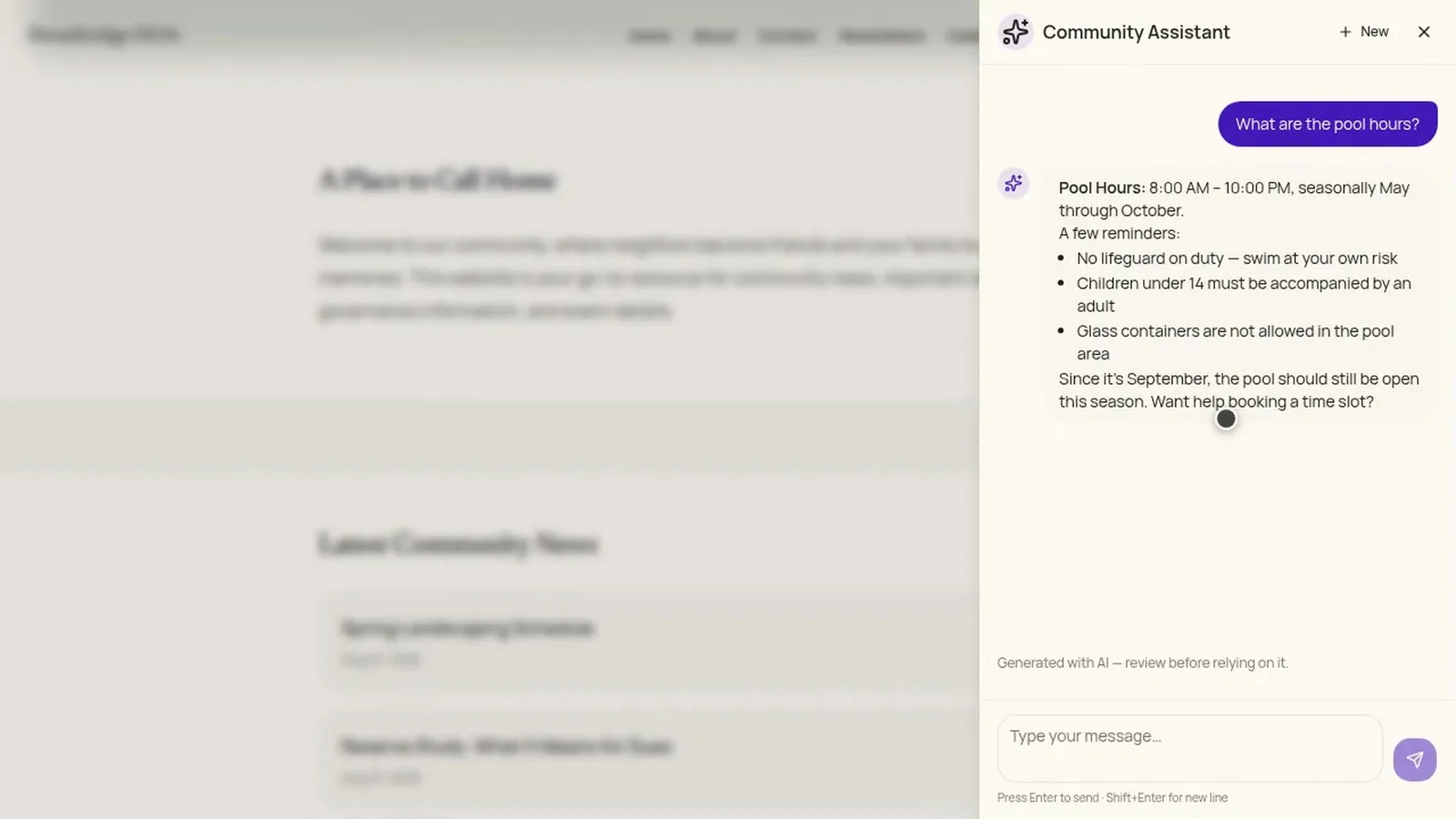
Most of what a board gets asked has already been answered in writing. Pool hours, fence height, when dues are due. The answer sits in a document nobody opens, so somebody on the board types it out again from memory at nine on a Sunday night, a little differently each time.
Point those questions at an assistant that reads the community's own documents and answers out of them, and a resident gets your rule instead of a general one. It comes with the Premium plan. The board's side of it is the documents: they have to be in the library, and they have to be current.

The library is the only place it reads
The covenants, the bylaws, the architectural guidelines, the pool rules, the budget, the meeting minutes. The assistant reads all of it from the same document library the board already maintains.
So there's no second copy of the rules to keep in step with the first one. The file a board member uploads is the file the assistant reads, and setting a document up means uploading it and marking who it's for.
If your documents are still sitting with a management company, solve that part first. We wrote up how the handover works in moving your HOA records out of a management company.
One mark on the file does two jobs
Every document is marked with who it is for: anyone, residents, or the board.
That single mark decides who can open the file. It also decides who the assistant will repeat it to. There's no second set of permissions to keep in step with the first one, which rules out the usual way these drift apart.
A reserve study marked board only won't open for a resident, and the assistant won't quote it to one either. That document was never in front of it for that conversation.
What a resident sees
On the community website, the assistant sits in the corner of the page, at whatever hour somebody has a question.
The question gets asked in plain conversational language, the way somebody would ask a neighbor over the fence. No keyword search, no navigating to the right PDF, no knowing which document a rule lives in.
What comes back is the answer, plus the rest of the rule the person didn't know to ask about. Ask about pool hours and you get the hours, then no lifeguard on duty, children under fourteen accompanied by an adult, no glass in the pool area. The pool document, being read.
For a board, the useful part is where the answer came from. It came out of the file, not out of whoever happened to reply, and it reads the same for everyone who asks. The same argument sits behind violation notices that stay consistent: a rule applied differently depending on who answered the phone gets harder to enforce.
When nothing covers the question
Ask it something the community has never written down, and watch what it does with the gap.
Take holiday decorations, and when they have to come down. In the walkthrough above, the assistant searches, finds nothing that covers it, and says so. Then it offers to send the question to the board.
Check that behavior in any assistant a board puts in front of residents. One that improvises a plausible-sounding rule creates a problem the board hears about later, usually from the resident who relied on it. An offer to route the question to the board is the useful answer to a question nobody has answered yet.
Writing the rule once
So the board writes the policy. Once. Then puts it in the library with the others, marked residents rather than anyone, because it's a rule for the people who live here.
Once the file is in the library, the assistant can read it a few seconds later.
The same resident asks the same question again and gets January 15th, read back off a policy that didn't exist a few minutes earlier. The date is the one the board chose. Nothing was configured or re-indexed by hand. Somebody wrote the rule down and put it with the others.
What it will not know
The assistant is only ever as current as the library.
An amendment sitting in somebody's inbox isn't a rule the assistant knows about, and it'll keep quoting the old one, in the same steady voice it uses for everything else. It has no way to know the difference, and it will not sound uncertain.
That's the trade. Keep the documents current, and the Sunday night questions get answered on Sunday night, out of what the community already wrote down.
Common questions
Does the assistant need its own copy of our documents?
No. It reads the same document library the board already maintains. Setting a document up means uploading it and marking who it is for.
Can a resident get an answer out of a board-only document?
No. The visibility mark on a file governs both who can open it and what the assistant will quote. A board-only reserve study is not available to a resident conversation.
What happens if we have never written a rule down?
The assistant says it found nothing covering the question and offers to send it to the board.
How long after uploading a document can the assistant use it?
A few seconds.
What happens if our documents are out of date?
The assistant answers from what is in the library, so it will quote the old rule until the new one is filed. Keeping the library current is the board's side of the arrangement.
Do residents need an account to ask a question?
To reach anything marked residents, yes. A signed-in resident reaches documents marked residents and documents marked anyone, never the board-only ones. There is also a pre-login assistant on the public site, which reaches only what is marked anyone.
Which plan includes it?
The 24/7 resident assistant is part of Premium. The pricing page has what sits in each plan.
Want to see it running? Get in touch and we will set up a walkthrough with a founder.