
Three board members write three different letters for the same rule. One quotes the covenant, one does not. One gives thirty days, one gives fourteen. And the notice that gets argued with is always the one that was worded differently from the last one. The walkthrough below shows the fix: decide the wording once, keep it in a template, and let the dates and amounts come off the record itself.

Consistency is not a matter of trying harder. It is a matter of where the wording lives. If it lives in somebody's head, or in the last letter they can find, it will drift. If it lives in a template attached to the rule, it cannot.
Write the templates once, per rule
Every rule the community actually enforces gets a template. Each one holds three things: the wording, how serious the violation is, and the section of the governing documents it comes from.
Writing the ones a community uses takes about ten minutes, and it is the ten minutes everything else depends on. After that, nobody has to remember how the last notice was phrased, because the phrasing is not in anybody's head. It is attached to the rule.
This is also the moment to decide severity, calmly, before it is about a particular neighbor. A trash can left out is not a fire lane blocked, and the templates are where that judgment gets made in the abstract rather than in the heat of a specific complaint.
Let the citation come from the documents
The covenant section does not have to be typed from memory either. Ask, and HOA-OS reads the governing documents the community has already uploaded and comes back with the section that covers the rule, for the board to keep or change.
That matters for two reasons. The obvious one is speed. The less obvious one is that a citation nobody had to look up is a citation nobody got wrong, and a wrong section number is the sort of thing an owner's attorney notices first.
Recording a violation takes one field
Somebody drives past a vacant rental and the grass is well past what the covenants allow. Here is what recording it involves.
Choose the template, and most of the notice is already written: what the violation is called, how serious it is, the description, and the rule it falls under. What is left is the address, which home this is about.
Save it, and the clock starts. Fourteen days to respond, counted from the day the violation was recorded rather than the day somebody found time to write a letter. That distinction is worth sitting with. A cure period that starts when a volunteer gets around to the paperwork is a cure period an owner can reasonably dispute.
The photograph lives on the record
The photograph of what was actually there goes on the violation itself. The evidence lives with the record instead of in somebody's phone, which is where it usually is when a board needs it eight months later and the person who took it has rotated off.
What the notice looks like
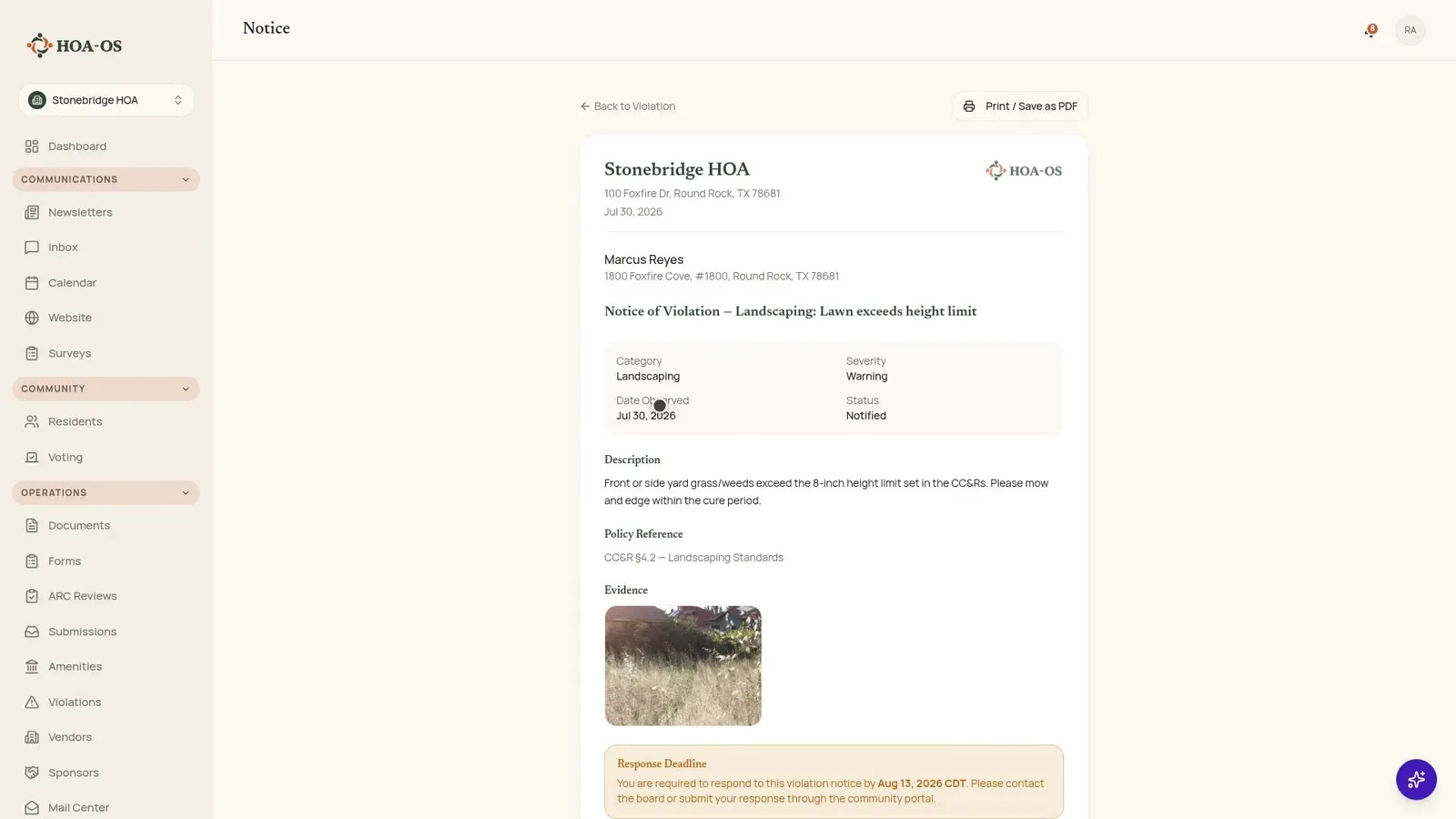
The finished notice carries the community at the top, the property it concerns, what was observed and when, the section of the governing documents it falls under, and the photograph underneath it.
None of it was written just now. It was assembled out of the record, which is exactly why the next one will look like this one. That is the whole argument for doing it this way: sameness is a byproduct of assembly, not of discipline.
The final notice already knows the first two
Some notices go in the mail, and some have been going for a while. Take a violation with a first notice at the start of July, a second one two weeks after that, and the car still sitting there.
The final notice already knows the rest. What the violation is. The section. What has been charged against the property so far. And the dates the first two letters went out, which nobody had to go and look up.
What it cannot work out, it asks for, instead of leaving a gap in the middle of a legal document. And the letter that goes out is filed against the violation with the other two, which is how the next one knows about this one.
Every category gets its own clock
That escalation sequence is not something anybody has to remember. Every category carries its own timetable: how long before a second notice, how long before a fine, and how much that fine is.
You set them once, per category, because a car blocking a fire lane is not a lawn that needs mowing and should not be on the same schedule. A board that runs one timetable for everything ends up either fining people over yard waste or letting a real hazard sit for a month.
Where a violation has got to, and everything that happened
On any single violation the board can see where it has got to and everything that has happened to it, in order, with the date each step was taken.
One caveat worth knowing: the clock follows the schedule, not the situation. If somebody mows the lawn on day thirteen and never tells you, the sequence keeps counting until a person looks at it and closes it out. The system tracks the process, not the yard.
Frequently asked questions
How long does it take to set up the templates? About ten minutes to write the ones a community actually uses. Every rule the board enforces gets one, holding the wording, the severity, and the section of the governing documents it comes from.
Do I have to look up the covenant section myself? No. Ask, and HOA-OS reads the governing documents the community has already uploaded and returns the section that covers the rule. You keep it or change it.
What do I have to fill in when I record a violation? The address. Choosing the template fills in the name, the severity, the description, and the rule it falls under.
When does the response clock start? The day the violation was recorded, not the day the letter was written. In the walkthrough that is fourteen days to respond.
Where does the photo evidence go? On the violation record itself, so the photograph stays with the notice rather than on the phone of whoever took it.
Does a final notice pull in the earlier notices? Yes. It carries the violation, the section, what has been charged against the property so far, and the dates the earlier letters went out. Anything it cannot work out, it asks for.
Can different violations escalate at different speeds? Yes. Each category has its own schedule: time to a second notice, time to a fine, and the fine amount. You set them once per category.
What happens if an owner fixes the problem and does not tell us? The clock keeps counting. The sequence follows the schedule, not the situation, so somebody has to look at it and close it out.
Decide the wording before it is about anyone
That is the point of doing it this way. The wording gets decided once, calmly, before it is ever about anyone in particular. After that, every notice is the same notice with different facts in it.
For what belongs in the letter itself, HOA violation notices: what to include and how to send them covers the required elements. For the enforcement policy behind the templates, how to enforce your HOA rules fairly and consistently is the companion piece. Or take a look at HOA-OS and see how your own rules would sit in it.