

Most guides to special assessments end at the vote. The board reads the covenants, checks the notice period, counts the ballots, and then somebody has to actually bill it.
That last part is where a spreadsheet usually shows up, and where it usually goes wrong. Thirty-six lots, thirty-six lines typed by hand, and no way afterward to prove which one got missed.
This video walks the billing end of it in HOA-OS. Runtime is four minutes, and it covers one community, Stonebridge, raising the half of a $39,000 clubhouse roof its reserve doesn't cover, across every lot in the community.
Chapters
- 0:06 The decision is made, the billing is not
- 0:38 Where a special assessment lives
- 0:54 The same Create Charge button the dues use
- 1:05 The entry type
- 1:32 Choosing who it lands on
- 1:52 Amount, description, due date
- 2:16 One press, thirty-six rows
- 2:42 What the owner sees
- 3:10 What this does not do
A special assessment isn't a separate system
There's nowhere else to go. The ledger that already carries the quarterly dues, what's been paid against them and what's still open, is the same ledger the assessment lands in.
So there's no second place to look, and no owner statement that tells a different story than the ledger does.
One field makes it a special assessment
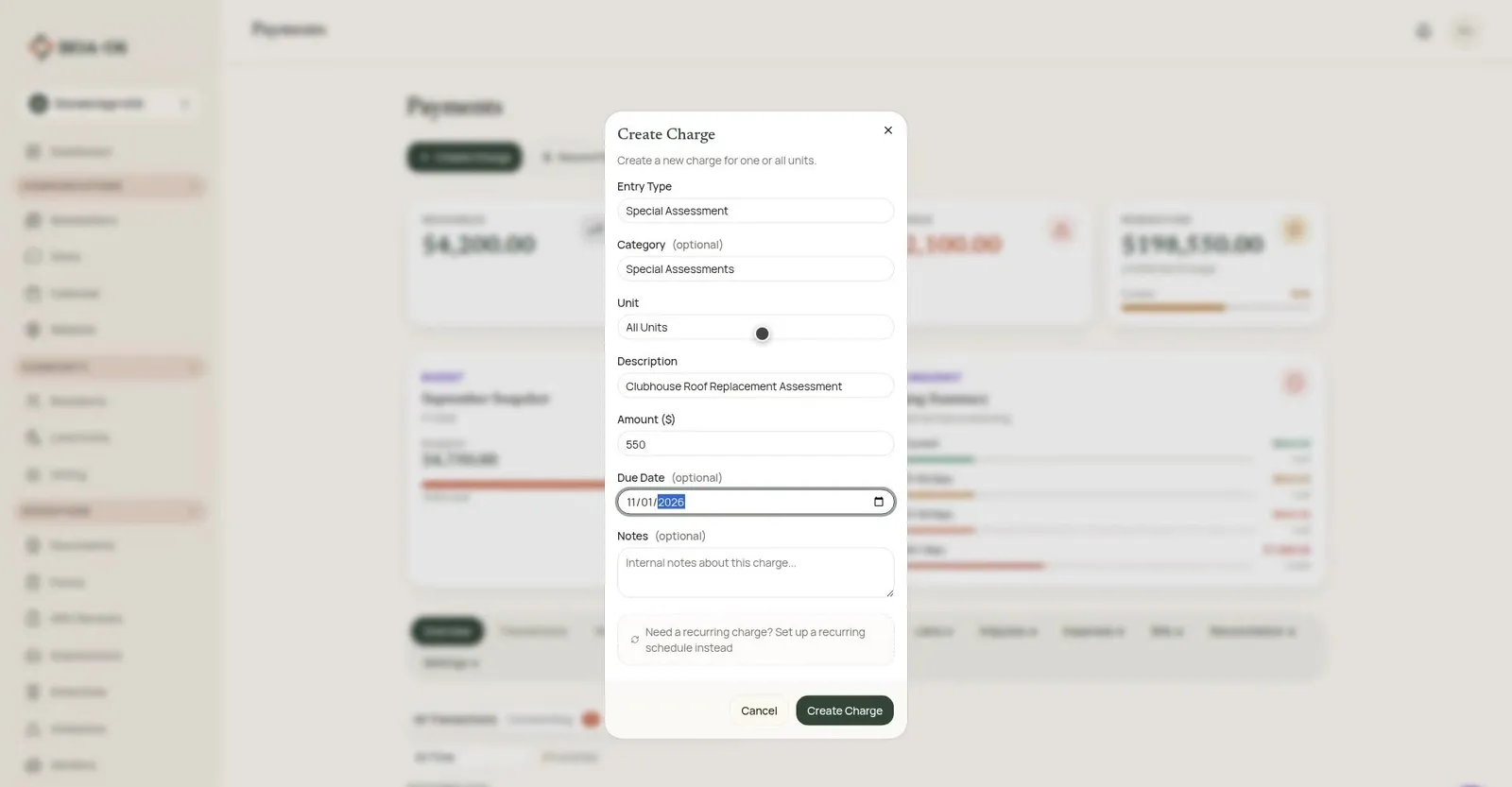
Creating it starts on the same Create Charge button the dues use. Inside that form, one field does the work: the entry type.
Special Assessment sits there as its own kind of charge, not a note somebody typed into the description. Picking it moves the category underneath to Special Assessments on its own.
That category move is what keeps the money apart from dues in the books afterward. A special assessment is raised once, for one thing. It isn't next year's income.
Who it lands on
The form can charge a single lot. Most charges are for one lot: a fine, a fee, one owner's balance.
A special assessment usually isn't. Leaving the form on All Units writes it across the whole roster in one press.
Then the ordinary parts: the amount per lot, a description written in the words an owner will read on their own statement, and a due date. In the video that's $550 a lot, due the first of November.
One press, thirty-six rows
The confirmation reads "Charge created for 36 units," and that number isn't a summary of what was attempted. It's how many rows were written, one for every lot on the roster.
Behind it are the thirty-six charges themselves, each marked Special, each unpaid, all carrying the same due date. Nobody typed thirty-six times, so nobody has to work out afterward which lot got missed.
What the owner sees
An owner signs in to the same place the quarterly dues get paid, and the assessment is sitting there beside them, with the amount and the due date.
They can pay it today rather than in November. The balance behind the pay button already includes it, and the due date isn't what makes it payable. What the due date does is decide when the row stops reading as open and starts reading as late.
What this does not do
HOA-OS records the assessment and collects against it. It does not check that the community was entitled to levy it.
The covenants and state law decide that. So do the vote, the notice period, and the ceiling on what a board can raise on its own. None of those is read anywhere in the form. It writes the charges either way.
The decision belongs with the board and the documents that bind it. What changes is the afternoon afterward: the charge is on every account the same day, in the same place the dues are, payable the same way, and countable by anybody who asks how much of it has come in.
Common questions
Does HOA-OS decide whether our board can levy a special assessment?
No. It records the charge and collects against it. Whether the community was entitled to levy it is settled by the covenants, state law, the vote and the notice period, and none of that is read by the form.
Can we charge a single lot instead of the whole community?
Yes. The form charges one lot or all of them. A fine or a one-owner balance uses the same form with a single unit selected.
Does the money get mixed in with dues in the books?
No. Choosing the Special Assessment entry type moves the category to Special Assessments.
Can an owner pay before the due date?
Yes. The charge is payable from the moment it's written. The due date decides when an unpaid row starts reading as late, not when it can be paid.
How do we see how much has come in?
From the same ledger the dues already run through, where the assessment sits alongside them.